

Locum Nurse Documents Checklist: What You Need to Start Working in Australia

October 30, 2026

Planning your next locum nursing contract? Here's a handy checklist of the documents you'll need to get started.


So you have decided to try locum nursing, and now you are looking at a long list of paperwork. That is completely normal. Every nurse who locums goes through it, and once your documents are organised, each new placement gets easier.


This post is a companion to our guide on how to locum as a nurse in Australia. That guide walks you through the whole journey, from registration to your first shift. Here, we zoom in on the paperwork so you know what each document is, why facilities ask for it and what to watch out for.


Facilities call this process credentialing, and it simply means confirming that you are who you say you are, that you are registered, and that you are safe to start work on their ward. This involves verifying your professional registration, qualifications, identity, clinical experience and other relevant clearances to ensure you meet the requirements of your placement.


Locum nurse documents checklist for working in Australia

What documents do locum nurses need in Australia?

The short answer:

To start working as a locum nurse in Australia, you will generally need current Ahpra registration, 100 points of photo identification, proof of working rights, your nursing degree, evidence of professional indemnity insurance, a nurse immuniser certificate, vaccination evidence, a National Criminal Record Check, ALS or basic CPR and an up-to-date CV with referees. Some placements also ask for a Working with Children Check or specialty certificates.

Here is each one at a glance.

Document What it shows Good to know
Ahpra registration You are a registered nurse No conditions that limit where you can work
Identity (100 points of photo ID) Who you are Include at least one photo ID
Working rights You can work in Australia Visa holders can check conditions online
Nursing degree or diploma Your training A copy of your degree or diploma
Indemnity insurance (certificate of coverage) Cover for your practice Confirm cover for each placement
Nurse immuniser certificate You are trained to vaccinate Clients increasingly ask for a HESA-approved course
Vaccination evidence and TB assessment Protection against infectious diseases The slowest item, so start early
Working with Children Check Child-related screening Only where your state or role requires it
National Criminal Record Check (police check) Your criminal history Accepted age ranges from six months to three years
ALS or basic CPR Current life support skills Some specialties ask for ALS
CV and referees Your experience Keep it current
Payment details How your agency pays you Your consultant confirms what applies

Not every placement asks for everything on this list, and some ask for more. The sections below explain each item in detail.

Additionally, for international nurses, visa conditions can affect where, when and how you work. Provide the correct visa documentation early so your consultant can identify any restrictions before presenting you for a role.


AHPRA Registration

First things first! To work as a nurse in Australia, you'll need current registration with the Nursing and Midwifery Board of Australia (NMBA), administered through the Australian Health Practitioner Regulation Agency (AHPRA). Your registration is the foundation of everything else.


You'll need to provide:

  • Your AHPRA registration number
  • Confirmation of your current registration status
  • Details of any registration conditions or restrictions, if applicable

Your recruitment agency or healthcare provider can verify your details through the AHPRA public register.


💡 Helpful tip: Check your registration renewal date before accepting a contract, particularly if your placement extends beyond your next renewal date.When you renew each year, you declare that you meet the Nursing and Midwifery Board of Australia's registration standards. Two of those are worth keeping records for, because agencies and facilities may ask about them:

  • Continuing professional development: at least 20 hours each year that is relevant to your practice
  • Recency of practice: at least 450 hours of practice in the past five years


You can read the full detail on the Nursing and Midwifery Board of Australia website.

Your CV and referees

Your CV is how your consultant matches you to the right role, so it is worth keeping it current. Include your employment history with dates, the specialties and settings you have worked in, the systems you are comfortable with and any extra training.


Most agencies also ask for professional referees, usually recent managers or nurse unit managers who can speak to your clinical practice. Let your referees know in advance that a call or email may be coming, which keeps things moving.


💡 Helpful tip: Make sure your CV is up to date and any gaps in your employment history are explained. This helps recruiters and healthcare providers better understand your experience and career journey.


Proof of identity (100 points of photo ID) and working rights

You'll need to provide documents to verify your identity as part of the credentialing process. This generally involves providing documents that meet a 100-point identification check, with at least one of those documents to include your photo.


Accepted documents can include:

  • Passport
  • Australian driver's licence
  • Birth certificate
  • Medicare card
  • Other approved identification documents


You'll also need to provide evidence of your eligibility to work in Australia, such as citizenship, permanent residency or relevant visa with permission to work. Visa holders can check their conditions through the Visa Entitlement Verification Online service.


💡 Helpful tip: Make sure your identification documents are current, clearly scanned and consistent with the name on your AHPRA registration. If your name is different on any of your documents, include evidence of the change so the paperwork lines up.


Nursing Degree or Qualification Certificate

You'll need to provide a copy of your nursing qualification to verify your education and professional credentials.


This may include:

  • Bachelor of Nursing degree
  • Diploma of Nursing
  • Postgraduate nursing qualifications
  • Other relevant specialty certifications


If you hold multiple qualifications, it's worth keeping digital copies of all your certificates in one place.


Professional indemnity insurance (certificate of coverage)

Professional Indemnity Insurance (PII) is an important requirement for nurses practising in Australia. Under the NMBA's registration standards, nurses must have appropriate professional indemnity insurance arrangements in place for their practice.

Depending on your employment arrangements, this coverage may be provided through your employer, professional association or an individual insurance policy.


You'll need to have evidence of your coverage ready, such as:

  • A current Certificate of Coverage or Certificate of Currency
  • Evidence of your professional indemnity insurance arrangements
  • Confirmation that your coverage is appropriate for the proposed role


💡Helpful tip: Before starting a contract, confirm that your insurance arrangements cover the type of nursing work you'll be undertaking. For locum work, the simplest approach is to ask your consultant how cover works for each placement, and to confirm it covers the full scope of what you will be doing. If you hold your own policy, keep your certificate of currency (also called a certificate of coverage) in your document folder. You can read the Board's professional indemnity insurance standard for more details.


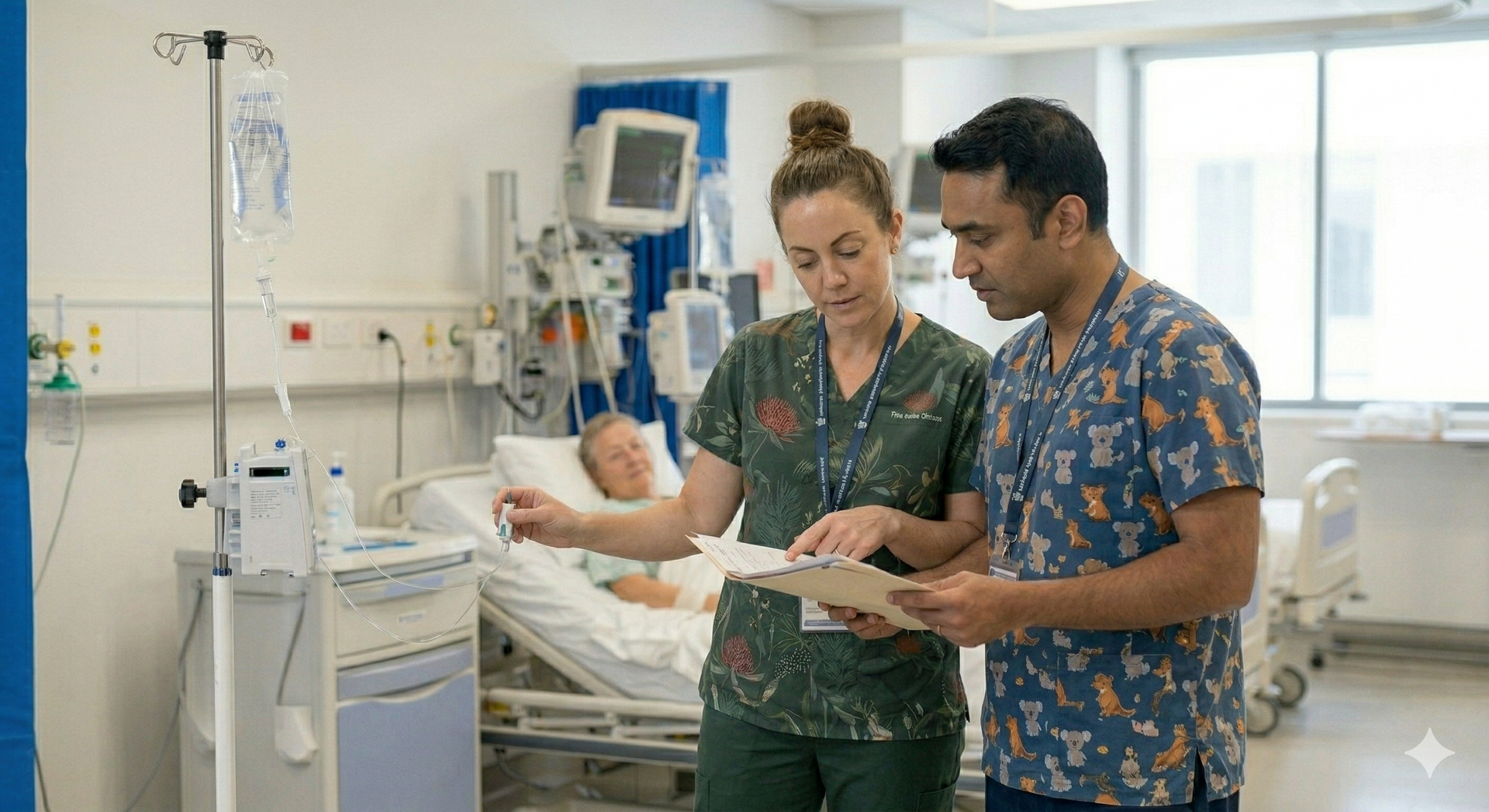
Nurse reviewing AHPRA registration and qualification documents

Nurse Immuniser Certificate

Your Nurse Immuniser Certificate is another important document to have ready when preparing for locum nursing placements.

Healthcare providers increasingly pay close attention to immunisation training and whether qualifications meet recognised accreditation standards.


Certificates from Health Education and Services Australia (HESA) accredited programs are highly preferred, and placements can be harder to secure without one. HESA accredits immunisation education programs against the National Immunisation Education Framework for Health Professionals.


If you already hold a Nurse Immuniser Certificate, it's worth checking whether your qualification was obtained through a recognised program and keeping a copy readily available.You can explore the
list of HESA-accredited immunisation programs.


💡Helpful tip: If you're considering new immunisation training, we'd recommend choosing a HESA-accredited course. This can give you an added advantage when applying for locum nursing roles and help you meet the requirements of a wider range of healthcare providers.

Immunisation and Vaccination Evidence

Healthcare workers are required to provide evidence of relevant immunisations or immunity as part of their credentialing process.

Requirements differ between states, so here is NSW Health's policy as a guide. It asks health workers to show protection against:

Diphtheria, Tetanus and Pertussis

(the dTpa vaccine)

Measles, Mumps and Rubella

(MMR)

A Tuberculosis assessment, completed through an online form

Varicella (chickenpox)

Hepatitis B

Influenza

Most facilities accept an immunisation history statement from the Australian Immunisation Register, which you can download through myGov. Blood test results showing immunity (called serology) are accepted too, and NSW Health has its own vaccination record card that a GP or trained pharmacist can help you complete.


This is the part of the paperwork that can take the longest, because some vaccines are given in a course over several visits and blood tests take time to come back. If you are missing any records, it is worth booking in early.


Working with Children Check (WWCC)

A Working with Children Check or equivalent screening clearance is another important document to have ready. One thing to keep in mind is that WWCC requirements differ between Australian states and territories.


Whether you need one depends on the state and the role. Paediatric wards, children's services and child and adolescent mental health roles are the most likely to require one. Some states also exempt registered health practitioners in certain circumstances, and Queensland is one example. Others do not.


A clearance issued in one state may not automatically be accepted for a placement in another, so moving between states may mean applying again. If you will be working in disability settings, you may also be asked for an NDIS Worker Screening Check.


💡Helpful tip:  If you're considering interstate locum contracts, check the relevant state requirements early so your clearance doesn't delay your placement.

National Criminal Record Check (NCRC)

A National Criminal Record Check, commonly referred to as a National Police Check, is another key part of the credentialing process.

You'll need to provide a current check that meets the requirements of your healthcare provider.


Some health services only accept a certificate issued directly by a state or territory police service. NT Health, for example, does not accept checks from third-party providers.


Different health services may have different expectations regarding how recently your check was issued. 


💡Helpful tip: If you already have a National Police Check, check its issue date and confirm whether it can be used for your next placement before applying for a new one.


Basic Life Support (BLS), CPR or Advanced Life Support (ALS)

You'll also need to have your relevant life support training certificates ready.


These commonly include:

  • Basic Life Support (BLS)
  • Cardiopulmonary Resuscitation (CPR)
  • Advanced Life Support (ALS)


Your specific role and clinical responsibilities will determine the level of certification required. Facilities usually ask for a current CPR certificate, and most are valid for 12 months. Some specialties, such as emergency, intensive care and some theatre and recovery roles, may ask for Advanced Life Support as well.


Many facilities also ask for mandatory training, such as manual handling and infection control, along with any specialty certificates that suit the role. Remote, mental health, midwifery and aged care placements can have extra requirements, so check the details when a role comes up.


How Can You Make the Credentialing Process Easier?


A little preparation can go a long way when it comes to getting ready for a locum nursing contract. Here are a few simple ways to stay organised:


1. Keep digital copies of your documents

Create a dedicated folder for your nursing credentials, with clearly labelled copies of your identification, qualifications, certificates and clearances. Store sensitive documents securely and share them only through approved channels.


2. Check expiry dates regularly

Professional registration, life support training and certain clearances may need to be renewed or updated. Keeping track of these dates can help prevent last-minute delays.


3. Prepare early for interstate placements

If you're planning to work across different states or territories, make sure you have enough time to organise any additional screening or documentation.


4. Stay in touch with your recruitment team

Credentialing doesn't have to be complicated. Having someone guide you through the process can make a real difference, particularly when you're preparing for a new facility or an interstate assignment.

Ready for Your Next Locum Nursing Opportunity?


Getting your paperwork organised is an important first step towards your next locum nursing contract, but you don't have to navigate the process alone.


At Jon & Jon Medical, we work with nurses across Australia to connect them with locum opportunities suited to their experience, availability and preferred locations. Our nursing recruitment team can help you understand your credentialing requirements, coordinate documentation and assist with travel and accommodation arrangements where applicable.


Whether you're looking for your next contract or exploring locum nursing for the first time, we'd love to hear from you.

Register with Jon & Jon Medical and speak with our nursing team about your next opportunity.


New to locum nursing? Read our guide on How to Become a Locum Nurse in Australia to learn more about getting started.

Locum nurse in Australia
By Team Jon & Jon Medical • September 15, 2026
Learn how to become a locum nurse in Australia, from AHPRA registration and documents to finding the right agency, choosing roles and starting your first placement.
A rural Australian healthcare landscape.
By Team Jon & Jon • July 30, 2026
A practical guide to metro vs rural locum work in Australia: pay, lifestyle, clinical scope, and real-world insights from Dr Saunders on rural practice.
Map of Australia with colorful pushpins marking locations
By Team Jon & Jon • July 15, 2026
Understand the hierarchy of medical doctors in Australia. Explore locum opportunities and advance your career with us.

Wondering what locum doctors earn in Australia? Get 2025–2026 day rate ranges by specialty for both
By Team Jon & Jon • June 26, 2026
Wondering what locum doctors earn in Australia? Get 2025–2026 day rate ranges by specialty for GP, Emergency, Anaesthetics, Psychiatry, O&G, Surgery and more, from the team at Jon & Jon Medical.

Locum hospital in the Australian Northern Territory
By Team Jon & Jon Medical • June 1, 2026
Looking for locum jobs in the Northern Territory? Jon & Jon places doctors & nurses across Darwin, Alice Springs, Katherine, remote NT & more. Get started today.
Medical professional preparing for a locum placement in Australia.
By Jon & Jon Medical • May 25, 2026
Everything doctors and nurses need to start locum work in Australia: AHPRA registration, credentialing, insurance, ABN, and finding your first placement.

Bendigo Health | Locum Guide for Doctors and Nurses
By Team Jon & Jon • April 30, 2026
Considering a locum role at Bendigo Health? Learn what to expect, from onboarding and support to lifestyle and local insights for doctors and nurses | Jon & Jon

Doctor and nurse locum jobs Australia, Jon  & Jon locum agency
By Team Jon & Jon • April 21, 2026
Choosing a locum agency in Australia? Learn what really matters for doctors and nurses, from pay and panel agreements to support, logistics, and reputation.
Doctor Wellbeing in Australia: Addressing Burnout and Building Sustainable Medical Careers.
By Team Jon & Jon • March 17, 2026
Explore the latest Australian data on doctor wellbeing and burnout, plus expert insights on building sustainable medical careers in modern healthcare.

O&G specialist Dr John Svigos holding newborn twins, smiling in a hospital room.
March 7, 2026
O&G specialist Dr John Svigos shares insights on obstetrics, mentoring junior doctors, global maternal health and locum work with Jon & Jon Medical.
Show More