


Doctor registration in Australia: Your provisional AHPRA checklist
Updated August 2026
In 2024/25, more than 26,700 internationally qualified health practitioners gained registration to practise in Australia, highlighting the important role overseas-trained clinicians play in the health workforce.
Doctors (formally classified as medical practitioners) accounted for 4,947 of those registrations, or almost one in five.
If you’re an international medical graduate (IMG) planning to work as a doctor in Australia, understanding the registration process is an important part of getting started. Medical registration in Australia is managed by the Medical Board of Australia, with applications administered through the
Australian Health Practitioner Regulation Agency (Ahpra).
Depending on your pathway, you may need to verify your qualifications, provide evidence of your identity and registration history, meet English language requirements and arrange supervised practice. This guide breaks down the key requirements for provisional medical registration in Australia, so you know what to prepare, what to expect during the application process and what comes next.
Quick Summary: Provisional AHPRA registration
Provisional registration is available to eligible international medical graduates progressing through certain registration pathways, including the Standard and Competent Authority pathways. Your exact requirements will depend on your pathway, qualifications, registration history and proposed position. Applicants will need to verify their medical qualifications, meet Ahpra's registration standards and provide evidence relating to their registration, identity, employment and supervised practice.
Requirements can change, so always check the latest Ahpra and Medical Board of Australia guidance before submitting your application.
First, which registration pathway applies to you?
There isn't one registration pathway for every overseas-trained doctor. Depending on your qualifications, previous assessment, training and specialist status, you may be eligible for the Standard pathway, Competent Authority pathway or one of the specialist pathways.
Understanding your pathway
first is important because it determines the assessments, documents and type of registration you may need.
Standard pathway
The Standard pathway generally applies to IMGs who are not eligible for the Competent Authority or Specialist pathways. Doctors on this pathway complete the relevant Australian Medical Council (AMC) assessment requirements.
IMGs who have successfully completed the required AMC examinations and received an
AMC Certificate can apply for provisional registration before completing the supervised practice required to progress towards general registration.
Competent Authority pathway
The Competent Authority pathway is available to eligible IMGs who have been assessed by a Medical Board-approved competent authority and have practised in a competent authority country. Doctors eligible for this pathway do not need to sit the AMC examinations.
Once provisional registration is granted, doctors complete a period of supervised practice in Australia before becoming eligible to apply for general registration.
Specialist pathways
If you already hold a specialist qualification overseas, a Specialist or Expedited Specialist pathway may apply instead. For some doctors, the AHPRA expedited pathway may provide a more direct route to specialist registration, depending on specialty, qualifications and eligibility.
Registration requirements differ depending on the pathway. Some specialist applicants may hold limited or provisional registration while completing additional requirements, while eligible doctors progressing through the Expedited Specialist pathway may apply for specialist registration.
- Specialist pathway – specialist recognition: For overseas-trained specialists whose qualifications need to be assessed by the relevant Australian specialist medical college.
- Expedited Specialist pathway: For eligible specialists who hold a qualification on the Medical Board’s accepted qualifications list.
- Specialist pathway – area of need: For overseas-trained specialists filling a position that has been formally designated as an area of need.
Note: A separate short-term training pathway is also available for eligible specialist IMGs undertaking temporary specialist or advanced training in Australia.
We recommend confirming which specialist pathway applies to you and reviewing the requirements for that pathway, before working through the registration checklist.
Your provisional AHPRA registration checklist
The documents required will depend on your individual circumstances and registration pathway. However, these are some of the main areas international doctors should be prepared for.
1. Confirm your identity
You will need to complete Ahpra's proof-of-identity requirements as part of your application.
If you're applying from outside Australia, you'll generally need a current passport and additional supporting identity documents. Ahpra will provide instructions for completing its online identity-verification process after you submit your application. If your passport is not in English, include a certified translation.
If your name has changed or appears differently across your documents, you may also need to provide evidence explaining the change or variation.
Always follow the identity requirements provided with your application.
2. Have your medical qualifications primary source verified
International medical graduates need to have their medical qualifications independently verified.
This process is coordinated through the Australian Medical Council (AMC) using the Educational Commission for Foreign Medical Graduates' verification services. You will generally need to establish the relevant AMC and ECFMG/MyIntealth accounts and arrange primary source verification of your medical qualifications. Your primary medical qualification must also meet the eligibility requirements for your chosen registration pathway.
It's worth starting this process early, as primary source verification is separate from the Ahpra registration application.
3. Prepare evidence of your medical qualification
You may need to provide evidence of your primary medical degree and other relevant qualifications. If documents are not in English, you'll need to provide translations that meet Ahpra's requirements.
Make sure names, dates and qualification details are consistent across your supporting documents.
4. Provide evidence of your internship or comparable training
Depending on your pathway, Ahpra may require evidence that you have satisfactorily completed a medical internship or comparable period of training. This could include an internship certificate, letter from the relevant hospital or another form of official evidence.
Requirements differ between pathways, so check the checklist relevant to you.
5. Provide your registration history and certificates of good standing
If you have previously been registered as a medical practitioner outside Australia, you will need to provide details of your registration history. For provisional registration applications, this can include registrations held during the previous 10 years.
Ahpra may require a Certificate of Registration Status or Certificate of Good Standing from the relevant overseas regulatory authorities. These documents generally need to be provided directly to Ahpra by the regulatory authority and must meet Ahpra's currency requirements.
It's a good idea to request these early, particularly if you have been registered in several countries.
6. Complete the required criminal history checks
You must declare your criminal history as part of your registration application.
If you have lived or been primarily based in a country outside Australia for six consecutive months or longer as an adult, you will generally need to complete an International Criminal History Check through an Ahpra-approved supplier. You will also need an international check if you declare criminal history outside Australia.
Follow Ahpra's instructions carefully and make sure the personal details used for your check match those in your registration application.
7. Demonstrate your English language skills
Doctors applying for initial registration in Australia must meet the Medical Board of Australia's English language skills registration standard. There are several ways to meet the standard depending on your education, language background, work history and circumstances.
Applicants using an English language test pathway will need to meet the minimum requirements for an accepted test. The English language standard was updated in 2025, so it's important to check the current requirements before booking a test or relying on previous results.
8. Prepare your CV and employment history
You may be required to provide a curriculum vitae showing your qualifications and employment history. Make sure dates and employment information are consistent across your CV, application and supporting documents. If you have significant gaps in your practice history, you may be asked to provide additional information.
Depending on your pathway, you may need to provide your letter of offer, position description, a completed SPPA-30 Supervised Practice Plan and Supervisor’s Agreement, and the relevant DFLP-00 declaration as part of your online Ahpra application.
You'll also need to meet the Medical Board's current recency of practice requirements.
9. Secure an appropriate position and supervision arrangements
For many IMG pathways, provisional registration is linked to an appropriate position and approved supervised practice arrangements in Australia. The Medical Board currently uses specific supervision forms for IMGs, including the Supervised Practice Plan and Supervisor's Agreement for International Medical Graduates.
Depending on your pathway and proposed role, you may need documents such as:
- an offer of employment
- a position description
- details of your proposed supervisor
- a supervised practice plan
- employer or supervisor declarations.
Your employer or recruitment agency can often help coordinate the employment-related documents, but the registration decision remains with Ahpra and the Medical Board.
- an offer of employment
10. Check whether a PESCI is required
Some international medical graduates may need to complete a Pre-Employment Structured Clinical Interview (PESCI).
A PESCI is a position-specific assessment and isn't required for every IMG role. For example, PESCI requirements may apply to some doctors entering general practice through the Competent Authority pathway.
Check your pathway and proposed role before assuming one is or isn't required.
11. Apply through the Ahpra portal
Once you've gathered the information and supporting documents required for your pathway, you can lodge your application through the Ahpra portal.
Before submitting, check that:
- your name and dates are consistent across your documents
- your qualifications have been submitted for primary source verification
- registration history and certificates of good standing have been organised
- translations meet Ahpra's requirements
- required criminal history checks have been completed
- employer and supervision documents are complete where required.
Missing or inconsistent information can result in Ahpra requesting further information and may delay your application.
- your name and dates are consistent across your documents
Getting documents certified overseas
Some documents may need to be certified before they're provided to Ahpra. Certification must be completed in person by an authorised person. Certification over video or audiovisual link is not accepted.
Depending on where you are located, authorised certifiers may include people such as:
- a notary public
- a Justice of the Peace
- an Australian Consular Officer or Australian Diplomatic Officer
- certain eligible Australian-registered health practitioners or legal professionals.
- Ahpra also has specific requirements for the wording used when certifying documents and additional requirements for multi-page documents.
Before arranging certification, check Ahpra's current guidance so you know your chosen certifier is accepted.
What happens after provisional registration?
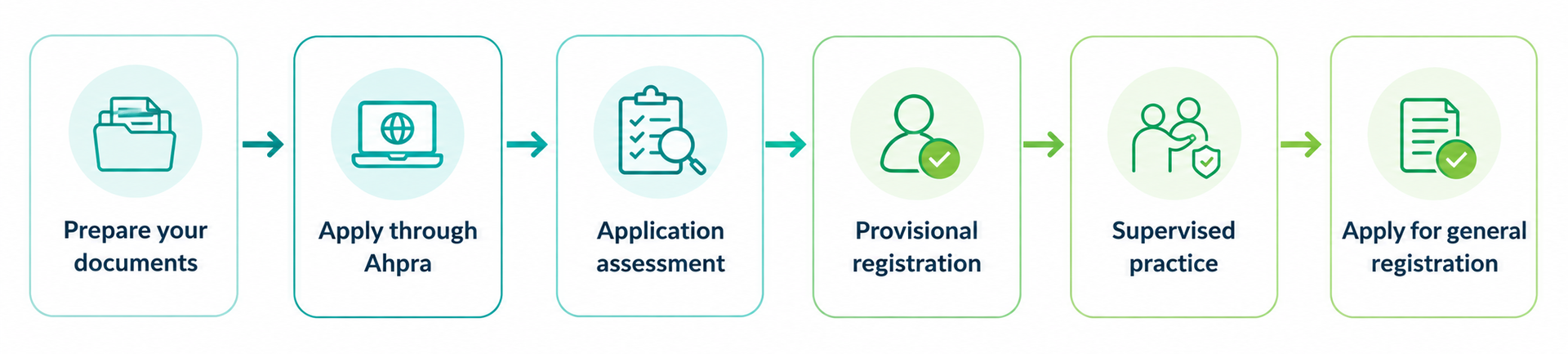
Provisional registration is generally a step towards general registration rather than the end of the process. For doctors on the Competent Authority pathway, this currently includes completing 12 months of supervised practice before progressing to general registration.
During supervised practice, you may also be required to:
- complete orientation to the Australian healthcare system
- work under Board-approved supervision
- complete relevant work performance reporting
- meet any other conditions attached to your registration.
Once you've satisfactorily completed the requirements for your pathway, you can apply for general registration.
A simplified journey can look like:
How long does AHPRA registration take for an overseas doctor?
There isn't one processing timeframe that applies to every international medical graduate.
Your timeframe can depend on multiple factors, including:
- your registration pathway
- primary source verification
- overseas registration checks
- criminal history checks
- supervision arrangements
- whether additional information is requested
- the complexity of your application.
For doctors progressing through the Competent Authority pathway, the Medical Board recommends applying well ahead of your proposed start date. Starting qualification verification and gathering your supporting documents early can help avoid unnecessary delays.
Can a recruitment agency help with AHPRA registration?
Recruitment agencies generally can’t manage or grant AHPRA registration. If you’re still working towards registration, the best place to start is with the Medical Board of Australia’s information for international medical graduates and the pathway that applies to you.
It’s also worth considering applying directly to hospitals and health services while you progress through registration. Recruitment agencies are engaged by health services to fill active vacancies, which usually involves an associated recruitment cost. Because of this, health services may be better placed to consider doctors who are still completing their registration requirements when they apply directly.
You can explore opportunities through the relevant state and territory health careers websites:
- New South Wales: https://www.health.nsw.gov.au/careers
- Victoria: https://www.health.vic.gov.au/careers
- Queensland: https://www.careers.health.qld.gov.au/
- Western Australia: https://www.health.wa.gov.au/careers
- South Australia: https://www.sahealth.sa.gov.au/careers
- Tasmania: https://www.health.tas.gov.au/careers
- Australian Capital Territory: https://www.health.act.gov.au/careers
- Northern Territory: https://healthjobs.nt.gov.au/
Once you hold the appropriate AHPRA registration and are ready to explore locum work, working with a trusted medical recruitment agency like Jon & Jon Medical can be a great next step in finding roles that suit your specialty, availability and preferred locations.
Source note:
This guide has been reviewed against current information published by the Australian Health Practitioner Regulation Agency (Ahpra), the Medical Board of Australia and the Australian Medical Council as at August 2026. Registration requirements vary depending on individual circumstances and can change. Always refer to the latest official guidance before applying.
Official guidance: Ahpra | Medical Board of Australia | Australian Medical Council
Once your registration is sorted, the next question is usually: where do you want to work?
If you're considering locum work,
choosing the right locum agency in Australia can make a big difference to how smoothly you move from registration into your first placement. You may also find our guide on
how to start locum work in Australia useful if you're planning your next step after AHPRA registration.
At Jon & Jon Medical, we help doctors and nurses explore locum and permanent opportunities across Australia based on their specialty, availability and preferred locations. Whether you're looking for your first role in Australia or your next locum placement, our team can help you understand your options and find opportunities that suit you.
Get in touch with our team.
Faq
Frequently Asked Questions
Do overseas doctors need AHPRA registration to work in Australia?
Yes. You must hold the appropriate registration with the Medical Board of Australia before practising medicine in Australia. The type of registration you need will depend on your pathway and circumstances.
Do all international doctors need to sit the AMC exams?
No. Doctors on the Standard pathway undertake the relevant AMC assessment requirements, while eligible doctors on the Competent Authority pathway do not need to sit the AMC examinations.
Different requirements apply to specialist pathways.
Can I apply for AHPRA registration while overseas?
Yes. International medical graduates can complete many parts of the registration process while overseas, including preparing their application, arranging primary source verification and gathering supporting documents.
Your specific requirements will depend on your pathway.
Do I need a job before applying for provisional registration?
For many IMG pathways, you'll need an appropriate position and approved supervision arrangements as part of your registration application.
Check the requirements for your pathway before lodging your application.
Do I need an international criminal history check?
Generally, yes if you have lived or been primarily based outside Australia for six consecutive months or longer as an adult, or if you declare overseas criminal history.
The check needs to be completed through an Ahpra-approved supplier.
What is the difference between provisional and general registration?
Provisional registration allows eligible doctors to practise while completing the requirements needed to progress towards general registration. These requirements commonly include a period of supervised practice.
Once you have satisfactorily completed the requirements relevant to your pathway, you may be eligible to apply for general registration.